Skip to content
Early preview The vault is just opening — new files are added regularly, and some sections are still being built.
VLTARIS
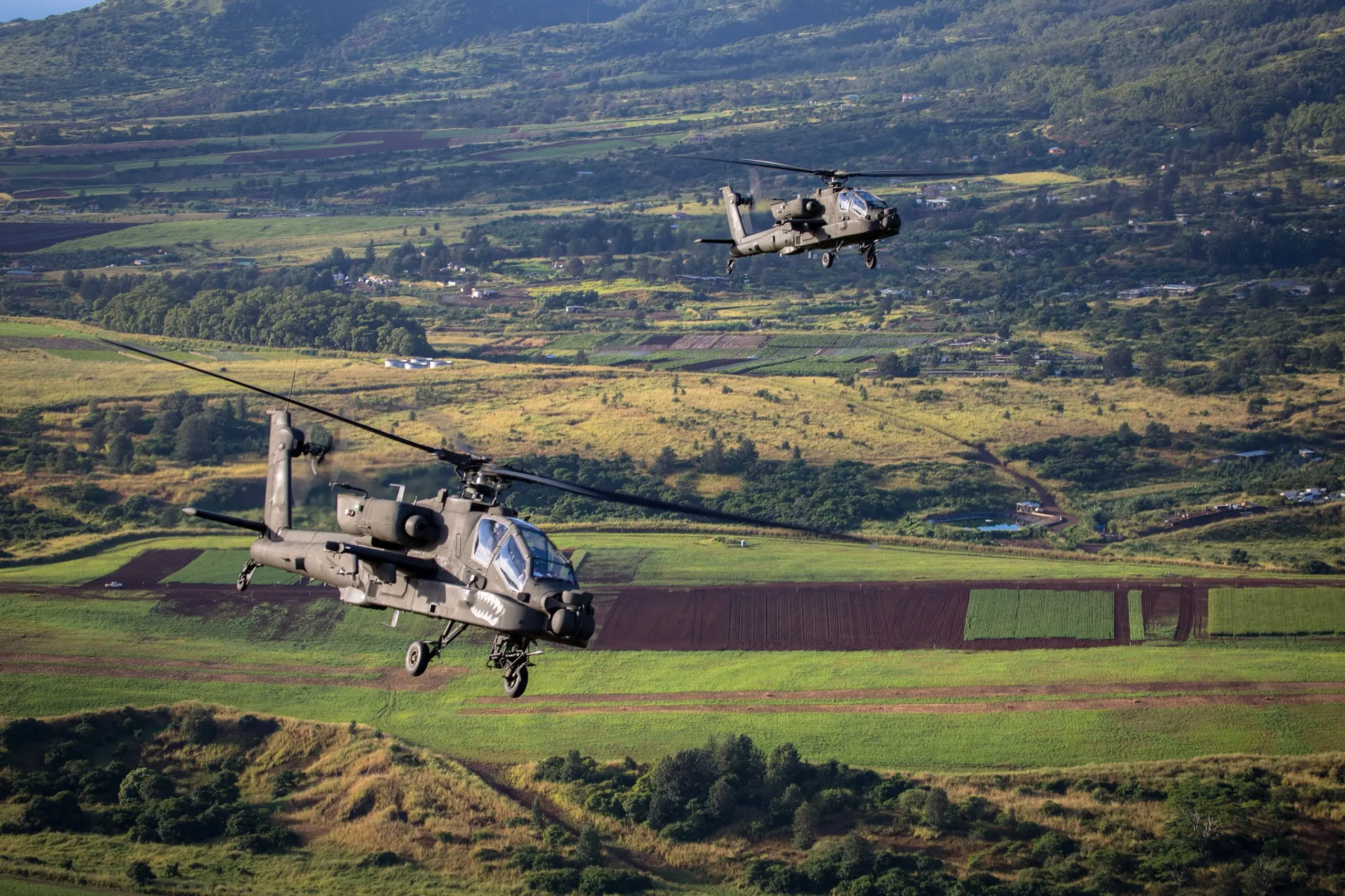
Two AH-64E Apache Guardians flying low in formation over green Hawaiian fields

helicopter · Modern · active

AH-64 Apache

An ambush that can fly

Hughes → McDonnell Douglas → Boeing

Built so far
2,875+
Countries chose it
19
Flight hours
5.3million
30 mm rounds on board
1,200

Here’s the thing about the Apache: it was built to hide. Not in the sky — in the landscape. It flies a few metres above the ground, slips behind a treeline, and raises just the top of its rotor mast above the leaves. Up there sits a radar that can sort hundreds of targets in seconds and pick the 16 that matter most. By the time anyone works out where the shot came from, the Apache has already dropped back out of sight. It isn’t a fighter jet. It’s an ambush that can fly.

The US Army ordered it in the 1970s for one terrifying job: stop waves of Soviet tanks rolling into Western Europe — at night, in bad weather, with nobody coming to help. So Hughes Helicopters built a flying tank-killer: armor around the crew, blast shields between the two cockpits, a 30 mm chain gun under the nose and up to 16 missiles hanging from stubby wings. It first flew in 1975. Half a century later, it’s still in production.

Then there’s the helmet. The gunner wears a monocle — yes, really — a little glass screen over the right eye that projects infrared video and targeting symbols. The gun is linked to it, so wherever the gunner turns their head, the gun turns with it. Look at the target, put the crosshairs on it, squeeze the trigger. Science fiction in the 1970s; standard equipment for forty years.

And it’s been busy. Its first war was Panama in 1989. Its most famous night was January 17, 1991, when eight Apaches crept into Iraq and fired the opening shots of Desert Storm. Since then the fleet has flown more than 5.3 million hours — over a million of them in combat — for 19 countries from the Netherlands to India to Australia.

The latest version, the AH-64E Guardian, keeps learning new tricks. Its crew can take control of a drone straight from the cockpit, and in 2026 Apaches started shooting drones out of the sky. The old tank-hunter has become a drone-hunter — and nobody seems to have told it to slow down.

Armament

30 mm chain gun
An M230 cannon under the nose with up to 1,200 rounds, firing 600–650 rounds a minute. It's slaved to the crew's helmet sight: it points wherever they look.
Hellfire & JAGM missiles
Up to 16 laser- or radar-guided anti-tank missiles on the stub wings. JAGM is the newer successor that fits the same launchers.
Hydra 70 rockets
Up to 76 unguided 70 mm rockets in pods, for area targets.
Optional extras
Some operators add air-to-air Stinger missiles. In 2025 the US Army test-fired the long-range Spike NLOS missile from an Apache at targets up to 25 km away.

Missions & Moments

Party in Ten

January 17, 1991, a little after 1 a.m. At a remote Saudi airstrip called Al Jouf, eight AH-64A Apaches of the 101st Airborne lift into the dark, split into two teams of four. Out in front fly four US Air Force MH-53J Pave Low helicopters, packed with the best navigation gear of the day. The plan, code-named Task Force Normandy, is simple to say and terrifying to do: fly into Iraq about 15 metres above the sand, find two early-warning radar sites, and erase them before the largest air campaign since the Second World War begins.

Those radars were Iraq's eyes on the border. Leave them standing, and the bombers coming in behind would be spotted minutes after crossing. When the plan was first floated, the battalion commander, Lt. Col. Dick Cody, was asked whether his Apaches could guarantee 100 percent destruction. His answer: "That's not a problem." No pressure.

The Pave Lows led the Apaches to a point just short of the targets, dropped chemical lights on the desert floor so the gunships could update their navigation, and turned for home. The Apaches went on alone. Through their night sensors, the crews watched the target sites from several kilometres out: generators, radar vans, communications bunkers. Then 1st Lt. Tom Drew keyed the radio: "Party in ten." Ten seconds.

At 2:38 a.m. the first Hellfires hit. One pilot sent his missile off with a dedication: "This one's for you, Saddam." Hellfires took out the radars and generators; rockets and 30 mm cannon fire took care of the rest. The whole attack lasted about four minutes.

Then came the code words everyone was waiting for: "California A-A-A." "Nebraska A-A-A." Both targets destroyed, no American casualties. Told the news, General Norman Schwarzkopf reportedly said just two words: "Thank God."

Twenty-two minutes later, at H-hour, coalition jets poured through the gap the Apaches had blasted in Iraq's radar wall. Desert Storm had begun — and the first shots had been fired by a handful of helicopters flying a few metres off the sand.

Cody's own Apache from that night, nicknamed Rigor Mortis, survived decades of upgrades. In January 2026 it went on display at the US Army Aviation Museum.

The crews

Two seats, one behind the other — and both crew are pilots. The pilot flies from the raised back seat. The copilot/gunner sits up front, running the sensors and weapons. New Apache pilots usually start in the front seat and move to the back once they're signed off as pilot-in-command. Armored blast shields separate the two cockpits, so a single hit can't take out both.

Yes, a monocle
The helmet sight (IHADSS) puts a small glass screen in front of the right eye, showing infrared video and flight symbols, while the left eye sees the real world. The 30 mm gun is linked to it: look at the target, and the gun follows.
Mostly warrant officers
In the US Army, most Apache pilots are warrant officers — career aviators rather than commanders. After flight school comes roughly six months of Apache training at Fort Rucker, Alabama (called Fort Novosel from 2023 to 2025).
Flying "in the bag"
In one training phase, a vinyl cover blacks out the cockpit windows, so students learn to fly on sensors alone — in broad daylight — before they ever fly at night.
The eyes in the nose
The turret under the nose holds the targeting and night-vision sensors, called Arrowhead. The pilot's night camera turns with the pilot's head, too.

Names worth knowing

  • Lt. Col. Dick Cody Task Force Normandy

    Led the eight Apaches that opened Desert Storm, flying the Apache nicknamed Rigor Mortis. He later became Vice Chief of Staff of the US Army.

  • 1st Lt. Tom Drew "Party in ten"

    His radio call — ten seconds to impact — started the attack that opened the 1991 Gulf War.

  • Capt. Dave Rigg & WO Ed Macy Jugroom Fort, 2007

    British Apache crews who landed inside a Taliban fort in Afghanistan, with Royal Marines strapped to the stub wings, to recover a fallen comrade. Their Apache is now in a museum.

  • Capt. Harry Wales Copilot/gunner

    Better known as Prince Harry. He flew as an Apache copilot/gunner from Camp Bastion, Afghanistan, from September 2012 to January 2013.

Did You Know?

"Hellfire" is an acronym: HELicopter Launched FIRE-and-forget.
An AH-64E crew can fly a drone from the cockpit — controlling its sensors, weapons and even its flight path.
The Longbow radar can sort up to 256 targets, in any weather, and pass the 16 most important to the crew — all from a dome sitting on top of the rotor.
By 2023, Apaches had flown more than 5 million hours. Boeing worked out that's 570 years and nine months of non-stop flying.
The tank-hunter is now a drone-hunter: in 2026, Apaches in Germany shot down drones air-to-air for the first time in Europe.
After its first combat in Panama in 1989, the operation's commander bragged you could fire a Hellfire through a window from four miles away at night — about 6.4 km.

Timeline

  1. Sep 30, 1975

    The Hughes YAH-64 prototype flies for the first time, competing against Bell's YAH-63.

  2. Dec 10, 1976

    The US Army picks the YAH-64 as its new Advanced Attack Helicopter.

  3. Jan 1984

    The first production AH-64A is delivered. The same year, McDonnell Douglas buys Hughes Helicopters.

  4. Apr 1986

    The first operational Apache unit begins training at Fort Hood, Texas.

  5. Dec 1989

    First combat in Operation Just Cause, Panama — more than 240 combat hours, mostly at night.

  6. Jan 17, 1991

    Task Force Normandy: eight Apaches fire the opening shots of Desert Storm, 22 minutes before H-hour.

  7. 1997

    The AH-64D Longbow, with its radar dome above the rotor, enters service. Boeing merges with McDonnell Douglas.

  8. Sep 1998

    The first Apache for the British Army is delivered — the WAH-64, assembled by Westland.

  9. Nov 21, 2013

    The AH-64E Guardian becomes operational with the US Army.

  10. Aug 13, 2024

    Poland signs for 96 AH-64Es — the largest Apache fleet outside the US.

  11. Mar 2026

    In Germany, US Army AH-64Es shoot down drones air-to-air: the tank-hunter becomes a drone-hunter.

The Apache family

Fifty years, three generations — and one British cousin. Same basic airframe, very different brains.

  1. AH-64A

    937 built

    US Army + exports · first flight Sep 1975

    The original tank-hunter: analog cockpit, no radar, and a nose full of night-vision sensors. It opened Desert Storm. The US Army flew its last A-model in 2012 — and even that one wasn't scrapped, but rebuilt as a D.

  2. AH-64D Longbow

    1,000+ built

    US Army + exports · first flight 1992

    Same airframe, new trick: a radar dome perched on top of the rotor. It can peek over a treeline, find targets in rain or dust, and hand the 16 most important to the crew — while the helicopter stays hidden.

  3. AH-64E Guardian

    890+ built

    US Army + exports · first flight 2008

    The current model: more powerful engines, composite rotor blades, modern electronics — and the ability to fly a drone from the cockpit. Most are rebuilt from older Apaches.

    You are here

  4. Westland Apache AH1

    67 built

    British Army · first flight Sep 1998

    Britain's own Apache, with Rolls-Royce engines and assembled in Yeovil. It flew hard in Afghanistan, retired in 2024, and was replaced by 50 AH-64Es.

Who flies it

19 countries fly the AH-64 Apache today.

  • United States

    US Army

    By far the largest fleet. The older AH-64D is being retired in favor of the E.

  • United Kingdom

    50

    British Army

    All AH-64E, replacing the Westland-built AH1.

  • Poland

    96

    On order, with deliveries from 2028 — the largest fleet outside the US.

  • Australia

    29

    AH-64E on order. The first arrived in October 2025.

  • Netherlands

    28

    The first export customer for the Longbow, now upgrading to the AH-64E.

  • Israel

    Flies the A and D models; a sale of 30 AH-64Es was approved in 2026.

  • Morocco

    First deliveries in 2025.

Also flown by: Egypt · Kuwait · India · Japan · South Korea · Taiwan · Singapore · Indonesia · Saudi Arabia · United Arab Emirates · Qatar · Greece

Fleet figures as of late 2025; numbers change as aircraft are delivered and retired.

Where to see one today

Most Apaches are still flying, so museum examples are rare — which makes these few special.

United States· 2

  • US Army Aviation Museum

    Fort Rucker, Alabama

    Dick Cody's Task Force Normandy Apache, which fired the opening shots of Desert Storm. Unveiled in January 2026.

    AH-64A “Rigor Mortis” · indoors
  • US Army Aviation Museum

    Fort Rucker, Alabama

    One of the original prototypes — kept in the storage hangar, usually seen on tours or open days. Its losing rival, the Bell YAH-63, is here too.

    74-22249YAH-64 prototype · indoors

United Kingdom· 1

  • Army Flying Museum

    Middle Wallop, Hampshire

    The Jugroom Fort rescue aircraft from 2007 — the only British Apache on public display.

    ZJ224Apache AH1 · indoors

Want to see one fly? Apaches are regular guests at airshows and military open days across Europe and the US.

Locations last checked October 2026. Airframes occasionally move — check with the museum before you travel.

Find it in

Sources

  1. Boeing — AH-64 Apache (production totals, operators, flight hours, specifications)
  2. U.S. Army — AH-64E fact sheet (2014)
  3. U.S. Army — Army Materiel Command weapons history (Panama, 2012)
  4. U.S. Army — Task Force Normandy aviators receive Distinguished Flying Crosses (2025)
  5. U.S. Army — History comes home to Fort Rucker (Rigor Mortis, 2026)
  6. U.S. Army — Operation Skyfall (air-to-air drone kills, 2026)
  7. U.S. Army — AH-64E initial operating capability (2013)
  8. U.S. Army — articles on crew seating, Apache pilot careers and the "bag" phase (army.mil 83797, 274991, 27020)
  9. U.S. Army Aviation Missile Command — Hellfire history
  10. Richard Mackenzie, “Apache Attack”, Air Force Magazine, October 1991
  11. Darrel Whitcomb, Combat Search and Rescue in Desert Storm (Air University Press, 2006)
  12. Northrop Grumman — AN/APG-78 Longbow radar
  13. UK Government — Prince Harry completes tour of duty in Afghanistan (2013)
  14. Army Flying Museum — Apache AH Mk1 ZJ224
  15. Vertical Flight Society — Advanced Attack Helicopter selection
  16. DSCA — Israel – AH-64E Apache helicopters (2026)